If you’re like me, you don’t even have to step onto the golf course or the tennis court to get “golfer’s elbow.” I’ve been dealing with an inside elbow pain that screams medial epicondylitis—but I haven’t even swung a club this year. Instead, my culprit turned out to be something much simpler: gripping a pull‑up bar too often with poor mechanics.
My pain showed up right where you’d expect: a very tender spot just below (distal) to the inside elbow bone, the medial epicondyle. In the early days, I could calm it down with cross‑friction massage and compression braces. But as the weeks dragged on, the usual “soft” care wasn’t enough. That’s when I leaned into something I commonly use in the clinic: dry needling.
Why Tennis Elbow & Golfer’s Elbow Happen
Tennis elbow (lateral epicondylitis) and golfer’s elbow (medial epicondylitis) are both tendinopathies of the wrist‑extensor or wrist‑flexor tendons where they attach to the bony epicondyles of the elbow. Despite the sporty names, these conditions are overuse injuries driven by repetitive gripping, lifting, or resisted wrist motion—not by how many matches you play.
In my case, the problem wasn’t golf—it was repeatedly gripping the pull‑up bar with my wrist slightly flexed, which increases tension on the flexor‑pronator mass inserting at the medial epicondyle. Over time, this leads to microtears, failed healing, and a buildup of disorganized tissue and inflammatory mediators at the tendon–bone interface.
What Dry Needling Does at the Tendon
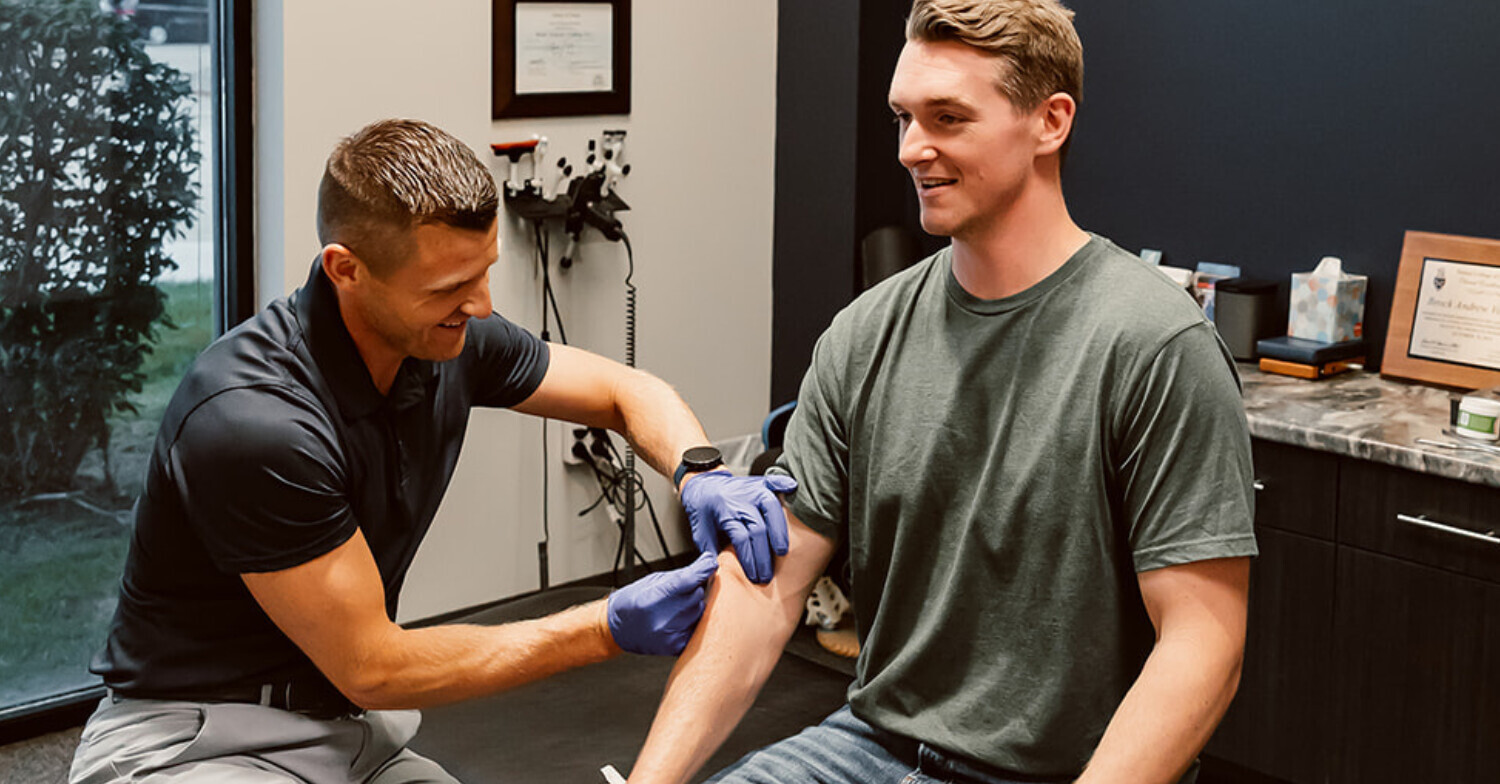
Dry needling involves inserting very thin, sterile needles into the tendon‑insertion site (in golfer’s elbow, right at or near the medial epicondyle) and into the surrounding tight muscles. In this case, I focused on the forearm flexor‑pronator mass where it attaches to the medial epicondyle.
Here’s what happens under the skin:
-
Needling creates controlled microtrauma at the tendon, which stimulates new blood vessel formation and increases blood flow. More blood means more oxygen and nutrients reaching an area that was previously “stuck” and under‑circulated.
-
The needles help release tight tissues and fascial tension in the flexor‑pronator muscles, reducing the mechanical pull on the tendon insertion.
-
This sets off a cascade of healing events: immune cells, fibroblasts, and growth factors are recruited to the area, helping the tendon shift from a chronic, painful state into a more organized, remodeling phase.
In short, dry needling turns a chronic, stagnant tendinopathy into an active, healing tissue—without surgery or injections.
Electro‑Dry Needling: Taking It One Step Further
In my own treatment, I went beyond simple dry needling by attaching small electrodes to the needles and running a gentle electrical current (electro‑dry needling). This neuromodulatory technique:
-
Boosts local blood flow and cellular activity more than needling alone.
-
Calms down local pain signaling, so the area feels less “twitchy” and reactive.
-
Encourages more robust tissue remodeling by keeping the area in a low‑grade, pro‑healing state between sessions.
For my inside‑elbow pain, this extra layer of electrical stimulation meant that each treatment session had a stronger “reset” effect on the tendon–bone interface.
Why Cross‑Friction and Braces Don’t Always Cut It
In the early stages of elbow tendinopathy, cross‑friction massage and compression braces (like epicondylar straps) can be helpful:
-
Cross‑friction massage helps break up adhesions and can modestly stimulate local blood flow.
-
Braces offload the tendon by spreading tension across adjacent tissues, giving the irritated area a chance to calm down.
But when weeks pass and the tendon remains painful and stiff, these passive measures alone rarely remodel the tissue. That’s when active, targeted interventions like dry needling and eccentric loading become essential.
The Role of Eccentric Loading in Healing
After a round of dry needling (and especially electro‑dry needling), the stage is set for eccentric strengthening—a cornerstone of tendinopathy rehab. Eccentric exercises:
-
Build stronger, more organized tendon fibers over time.
-
Increase the tendon’s ability to handle load, which reduces pain during daily activities like gripping or pulling.
In my own plan, I combined 2 dry‑needling sessions per week for 3 weeks with a simple home program of eccentric wrist flexor curls (forearm on a table, palm up, slowly lowering a light weight or resistance band). Within a few sessions, the pain began to subside, and the tendon felt less “irritable” to touch.
How It Played Out for Me
For my golfer’s elbow, the results were surprisingly fast:
-
After 1 treatment, my pain dropped by about 50%.
-
After 2 dry‑needling sessions per week for 3 weeks, the once‑tender spot near my medial epicondyle was no longer painful to palpate, and I could do pain‑free pull‑ups again.
-
And, to be honest, I’m still not swinging a golf club—but I’m also not hiding from the pull‑up bar.
This is exactly what I tell my patients: you don’t have to “live with” elbow pain just because you grip a bar, twist a wrench, or swing a racquet for a living. Modern rehab, including dry needling plus eccentric loading, can remodel the tendon and restore function.
Bottom Line: Dry Needling for Tennis & Golfer’s Elbow
If you’re struggling with inside or outside elbow pain that flares with gripping, lifting, or pulling:
-
Dry needling at the tendon‑insertion site (medial or lateral epicondyle) can disrupt stagnation, increase blood flow, and trigger natural healing.
-
Adding electrical stimulation (electro‑dry needling) can amplify blood flow and calm pain signaling.
-
Pairing needling with eccentric loading exercises drives true tissue remodeling and long‑term recovery.
You don’t have to wait until you’ve “earned” your elbow pain on the golf course. Treat it early, treat it smartly, and you can get back to lifting, pulling, and playing—pain‑free.